The pitch, explained
How a rise ball rises
Spin rate, spin direction, pitch speed. A rise ball needs all three at once, and the third is the one a developing pitcher cannot meet yet.
Chapter 01
The three components
A softball does not rise because it was thrown hard. It rises because air behaves differently over the top of it than underneath, and that only happens when three separate conditions are met at the same moment.
The first is the speed of spin: how many times the ball turns over per second between the hand and the plate. The second is the direction of that spin, which has to be backwards, on four seams, cleanly rather than in a wobble. The third is the speed of the pitch itself, because spin on a slow ball does nothing at all.
Coaching almost always compresses these into a single instruction, which is to throw harder. That is only one of the three, and for most pitchers it is the one least under their control.
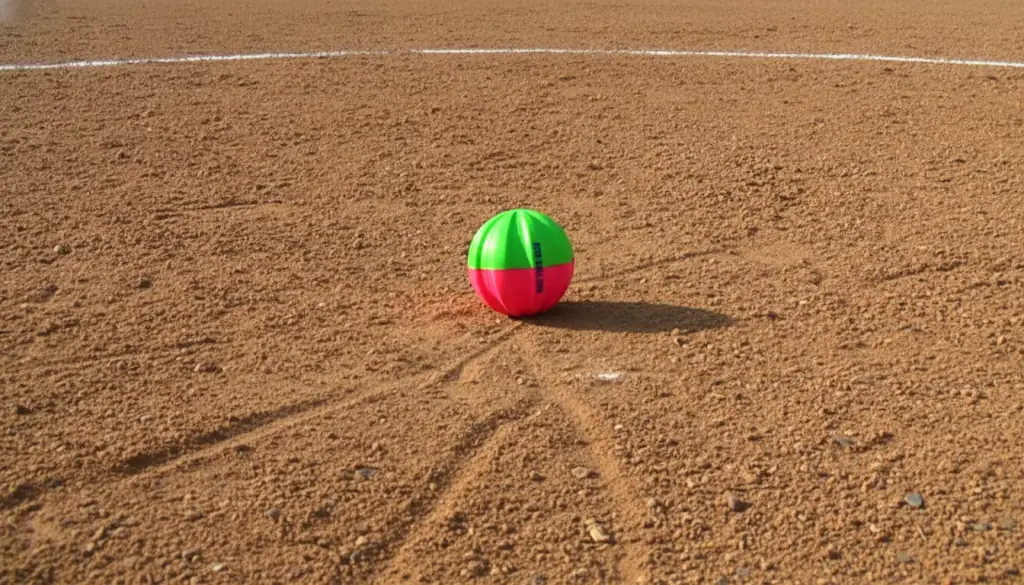
An EZ-Riseball sitting on the packed dirt of a pitching circle, chalk arc behind it
The numbers, side by side
A good rise ball needs tremendous backspin, and the working figure is at least 20 to 25 revolutions per second. Twenty full rotations in about the time it takes to say the number. The four seams must be spinning backwards, and fast.
On top of that, a regular softball needs a release speed with a minimum in the mid fifties, and it really wants to be nearer 65 mph before the rise becomes something a batter notices.
An EZ-Riseball changes both thresholds. The eight moulded wings catch air in a way a smooth softball cannot, so the ball lifts at around 10 revolutions per second, at a minimum of about 30 mph. Half the spin rate, a little over half the speed.
Chapter 03
Why a young pitcher never feels it
This is the part worth sitting with. A twelve year old is not throwing 55 mph. Plenty of high school pitchers are not either. So she can hold the correct grip, supinate correctly, generate genuine four seam backspin, and the ball will still travel flat, because the third condition was never available to her.
What she learns from that is not that her mechanics need work. What she learns is that she cannot throw a rise ball. The pitch gets shelved for a year, and the year after that, and the technique never gets built during the seasons when it would have been easiest to build.
Lowering what the ball needs is the other way round the problem. The mechanics being practised are the same mechanics; only the threshold at which they produce visible movement has changed.
Working out which component is missing
Before changing anything, find out which of the three is short, because the fix is different in each case and they look identical from the front.
Stand behind the pitcher and watch the ball rather than the arm. If it is wobbling or turning sideways, the fault is direction, and that is grip and release work. If the spin looks clean and backwards but the ball still goes flat, the fault is rate or pitch speed, and that is what a training ball addresses.
Fix direction first in either case. It is the only one of the three that does not depend on how strong she is yet, and it is the component that carries into every other pitch she will ever throw.
EZ-Riseball, US Patent 9,750,986. Call (334) 531-4739.