Hands
The EZ-Rise grip
Fingers into the grooves, spin the wings on the release. A grip is not how you hold the ball, it is the mechanism that accelerates it on the way out.
Chapter 01
Where the fingers go
The index and middle finger run parallel to the seams, with the middle finger sitting on the seam itself. Underneath, the thumb and index form a C.
That C is doing more work than it looks like it is doing. It is what keeps the hand under the ball through the release rather than rolling over the top of it, and rolling over the top is what turns a rise ball into a flat ball without the pitcher feeling any difference.
On an EZ-Riseball there is a physical cue for all of this. The fingers set into the moulded grooves between the wings, so the hand has an edge to locate against instead of finding a position on a smooth surface by feel alone.
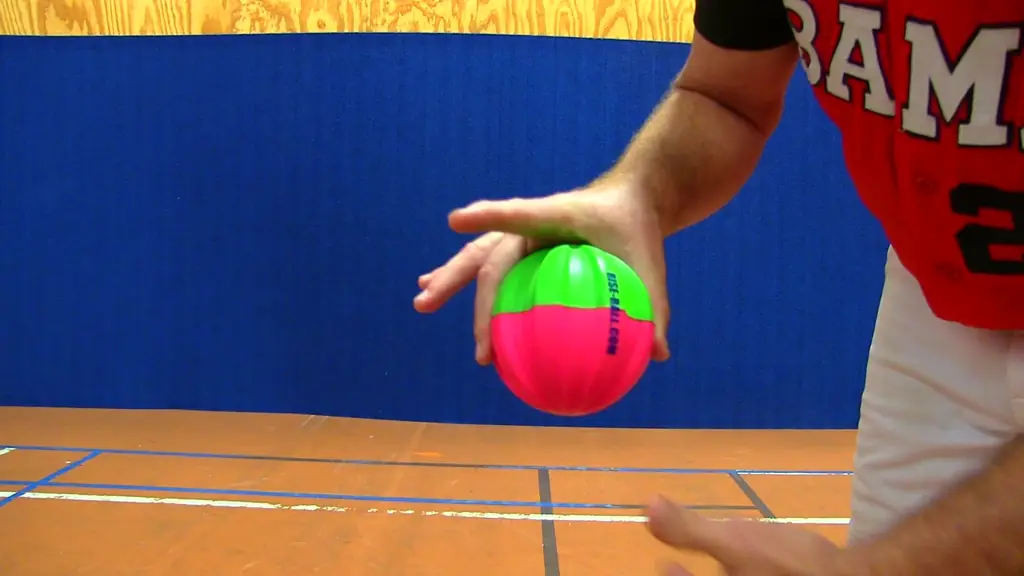
A pitcher's hand holding an EZ-Riseball with the fingers set into the moulded grooves
Three grips people confuse
The horseshoe grip lays the fingers across the horseshoe of the seam. It is a general starting grip and it is not a movement grip.
The drop ball grip is set up so the fingers can get up and over the top of the ball at release, with pressure from the index and middle finger on top.
The rise ball grip keeps the hand under the ball, fingers behind it, thumb and index in the C. Notice that the drop and the rise are close to opposites at the moment of release, which is why a pitcher who owns one is much nearer the other than she thinks.
Chapter 03
The grip is a spin machine
The most useful reframe here is that a grip is not a holding position. It is the mechanism by which the fingers are going to do work on the ball in the last few inches. If the fingers are not placed to push against something on the way out, the grip has failed however comfortable it feels in the hand.
That is what the grooves are for. The design puts an edge under the fingertips to drive against, which raises the rate of spin without the pitcher changing anything about her arm. What is being trained is the finger action, so it transfers back to a regulation ball rather than becoming a trick that only works with one piece of equipment.
Faults you can see from behind
Sideways spin almost always means the hand rotated somewhere in the arm circle rather than at the release. The C collapses, the thumb comes round early, and what should have been backspin becomes a lazy sidespin that does nothing at any speed.
No meaningful spin at all means the fingers are passengers. She is throwing with the arm and the hand is simply letting go. This one hides well, because the pitch can still be fast.
Spin that looks right but wobbles usually means the middle finger has come off the seam. Seam contact is what makes the rotation stable enough to count as four seam rather than something approximate.
EZ-Riseball, US Patent 9,750,986. Call (334) 531-4739.