The last few inches
The release point and the long step
Two cues carry the whole release. Both of them describe what the forearm and hand do in the final few inches, and both of them fail the same way when they happen early.
Chapter 01
Point your thumb to third base
For a right handed pitcher, finishing with the thumb pointing toward third base means the hand has supinated. The palm turns up and outward, which leaves the fingers behind and underneath the ball. That is the only position from which backspin is possible at all.
The cue is given spatially rather than anatomically for a good reason: nobody can think about supination while throwing. A body can chase a point in space at speed. It cannot chase a description of a joint.
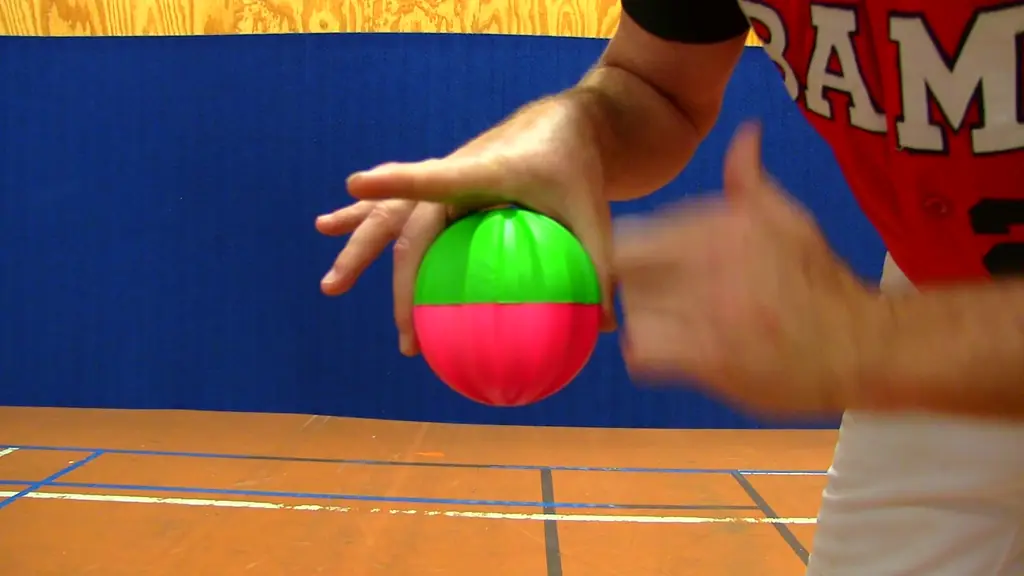
A pitcher's hand and forearm at the release, holding an EZ-Riseball
Turn the doorknob
The doorknob cue covers the motion rather than the end position. Imagine taking hold of a round doorknob and turning it outward, away from the body. That rotation, arriving late and fast, is what actually spins the ball.
Late is the load bearing word. If the rotation happens up in the arm circle, the hand reaches the release already turned and has nothing left to give. The pitch leaves flat, the pitcher assumes she needs more effort, and more effort usually moves the turn even earlier.
Chapter 03
The long step
The stride is part of the release rather than something that happens before it. A longer step lowers the body and moves the release point forward and down, which changes the angle the ball leaves on and gives the rise a longer runway to work over.
It also has to be the same length every time. If the stride varies, the hand is releasing from a different place on each pitch, and no grip will make that repeatable. Where the stride is inconsistent, fix the step before chasing the spin.
Why this part trains in hours
Here is the encouraging part of the whole delivery. The release is a small motion performed by small muscles, and the ball trains the muscles of the fingers, hand and wrist directly. Those adapt quickly, and the release point can come together in hours of focused work rather than the weeks people assume.
That only holds with feedback. Practising a release you cannot evaluate is repetition, and repetition locks in whatever you happened to be doing that day. Short sessions, close range, and a ball that moves when the release is right.
EZ-Riseball, US Patent 9,750,986. Call (334) 531-4739.