The drop ball is the same motion in reverse
Same approach, same stride, opposite hands at the end.
September 17, 2026 · 4 min read
Pitchers often treat the rise ball and the drop ball as two separate projects, taken up in separate seasons. They are closer than that. The approach is the same, the stride is the same, and what differs is a few inches of wrist and finger action at the end.
Wrist back
The first thing that has to be true for a drop ball is that the wrist stays back as the hand approaches the release. Not cocked hard, just not opened early. The inside of the wrist should be pointing toward the catcher as the hand comes through.
If the wrist opens early, the hand runs out of range before it can do anything useful to the ball, and the pitch becomes a flat fastball that happens to be aimed low. Low is not the same as dropping. A drop ball earns its name by breaking downward late.
Elbow close
The elbow stays close to the body through the release. When it drifts away, the arm has to compensate somewhere, and the compensation nearly always shows up as the hand rotating sideways. Sideways is the enemy of both pitches.
This is a good one for a parent to watch for from the side, because it is obvious once you know to look. If you can see daylight opening up between elbow and ribs at the release, that is the thing to work on next.
Up and over
The last piece is the fingers getting up and over the ball, with pressure coming from the index and middle finger on top. That pressure on top is what puts topspin on, and topspin is what makes the ball dive.
Compare that with the rise ball, where the hand stays under the ball and the fingers work behind it. Same arm, same stride, and then the hand either finishes above the ball or below it. Framed that way, a pitcher who has one pitch is much closer to the other than she thinks.
Why training them together is not a distraction
There is a sensible worry that learning two movement pitches at once will muddle both. In practice the opposite tends to happen, because the contrast is the lesson. Throwing five rise balls and then five drop balls makes the difference between the two releases physically obvious in a way that neither pitch does alone.
It also stops a pitcher drifting. A rise ball worked on in isolation slowly becomes a flat pitch thrown hard, because there is nothing pulling the hand back under the ball. Alternating gives you a reference point.
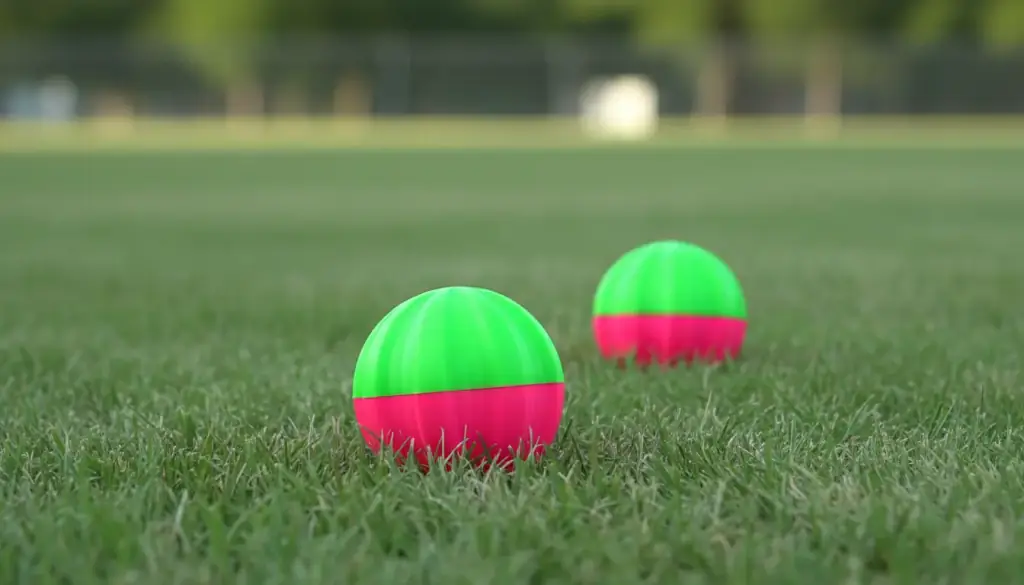
The EZ-Riseball is built as the all in one ball for rise and drop training for this reason, so the same tool tells you whether the hand finished above or below on any given throw.
A simple alternating drill
Work in blocks of five. Five rise, five drop, and then five where a parent or team mate calls which one as the arm starts moving. The called block is the one that matters, because a pitch you can only throw when you had time to prepare for it is not a pitch you can use in a game.
Keep the blocks short and stop while the mechanics are still good. Drop ball work degrades fast when the arm tires, and a tired drop ball teaches the wrist to open early, which is exactly the fault you came to fix.
What a drop ball is for
It helps to be clear about why the pitch exists, because that shapes how it should be thrown. A drop ball is not a low fastball. Its job is to look like a strike for most of its flight and then leave the zone downward late, so the bat arrives where the ball used to be.
Which means a drop ball that starts low is wasted. It has to start in the zone. Pitchers who aim low are usually compensating for a pitch that does not actually break, and the fix is in the release rather than the target.
The pair, not the pitch
The reason to own both is what they do to each other. A hitter who has seen a ball climb is a hitter who will swing over a ball that dives, and the reverse. Neither pitch is worth as much on its own as the two are together, which is the practical case for training them in the same session with the same ball.
That is also why the contrast drill matters more than the volume. Five and five, with the two releases put side by side, teaches the hand a distinction it will never learn from a hundred of either one.
EZ-Riseball, (334) 531-4739
Call (334) 531-4739